Yesterday I saw French couple walking their dogs. Actually, I heard them before I saw them. Little Precious I and Little Precious II were pitter-pattering, at just about the pace of their self-absorbed owners, through my guided historical tour. Only I and II had little weiner-legs suspended from their bellies, and jinglebells from their necks. My tour group oohed and awed and said how cute, but I just thought to myself: what on earth is the purpose of those damn jinglebells? Are your puppies in danger of flying off into the polar wildnerness and getting confused with Santa's flying reindeer? Do they normally pasture in Alpine meadows alongside your elderly bergher-neighbor Hansel's fondue-yielding cows? And why, in God's good name, are the bells that big? Giving Precious I and Precious II bells of that size is something along the lines of suiting Rudolph up with the Liberty Bell.
And you're going to jingle them through my tour for twenty minutes?!
Come on, man.
Friday, September 24, 2010

Saturday, May 30, 2009
Apology
I wasn't very nice in my latest blog posts responding to Johnny Adamic's analyses of Italian and American eating habits. Big apologies to Johnny – who is continuing in his role as “The Food Scholar” in an awesome program in Food Culture at New York University.
I’m removing my last series of posts. If anyone is really curious about lesser-known facts relating to bread, meat, or fish (or Italian or American food consumption statistics), you can let me know and I’ll fill you up with data – without the invective.
Tuesday, May 5, 2009
Arrogance 3, Science 0
What resulted was a telling confirmation not so much of any culturally specific eating habits but rather of the pronounced deficiency in nutritional awareness (in particular) and scientific thought (in general) that I’ve come to attribute to Italians. Constantly under gastronomic fire as the American-in-residence, I admit that such certifiable examples of arrogant ignorance by my Italian counterparts provide me a certain measure of amused, self-vindicating satisfaction; at the same time, though, I’ve continued to hope, for the general good of society, health, and science, that my rather offensive characterization of Italians has been much too broad, a stumble into the trap of generalizing from the particular and battling mindless offense with mindless offense. But the more Italians I meet and the more Italian media I read, the more I’m convinced that my analysis is dead-on.
I’ve mentioned before a few examples:
· My roommate, who sustains, “It’s just a Florentine steak with a little oil. Very light!” (Actual nutritional analysis: more than 1200 calories and 80 grams of fat)
· The Italian dietetic association, whose food pyramid suggests that cookies are a more highly recommendable foodstuff than lentils, and that lard is better for you than low-fat milk
· The Italian version of Wikipedia, which sustains that wheat bran is not fit for human consumption, and that whole-grain products should be limited to no more than one per day (otherwise threatening a whole host of menacing problems, including stunting the growth of children)
The Italians at my kitchen table, however, were all University students majoring in nothing less “scientific” than physics and should imaginably have been able to sustain a discussion and an analysis based in reason, deduction, logic, and research: the scientific method, if you please. But they weren’t.
As is usual, the Italians started their part of the conversation with an attack on the eating habits of Americans as compared with Italians (which, since we’re considering the Italian capacity for scientific thought, is an argument, among its many other deficiencies, entirely irrelevant to the question at hand). When I pointed out that, in fact, Italians eat more beef, pork, and animal fat than do Americans, they didn’t consider this incriminating, in fact sustaining that this is a-ok: while American meat products likely come from the supermarket or from McDonald’s, theirs generally come from “the butcher on the corner.” This may be true – or it may not be, as several of my data hunts have turned up surprising results – but even if it is, the sourcing of animal fat doesn’t change the way it attaches to the insides of human arteries, raises cholesterol, and promotes (if not “causes”) obesity, related diseases, and cancer. A salami bought at Giuseppe the Butcher’s and a salami bought at Wegmans Supermarkets stimulate those degenerative processes with equal effectiveness. Italian Arrogance 1, Science 0.
They sustained further that “animal fat isn’t bad for you; in fact, it’s necessary.” Otherwise, for example, it’s impossible – impossible! – to get adequate quantities of iron. While I’ve seen various reputable medical accounts sustaining diets with relatively high quantities of fats, all of these have required that the fats consumed be primarily vegetable- and fish-based (and principally omega-3) fats. Never have I seen any reputable study promote the consumption of animal fats. And further, does it make sense to construct a general societal eating program based on the nutritional needs of the relatively miniscule population of anemics? Would any of them similarly propose a new wheat-free national diet to guard against possible problems for those with celiac disease? Italian Arrogance 2, Science 0.
Next argument: “We have the Mediterranean diet” paired with “We don’t have the health problems you Americans have, so we must have a good diet”. In fact, the Meditteranean diet involves very, very little meat and certainly doesn’t comprehend trans-fat filled brioches at the bar: Italians absolutely do not practice the medically celebrated diet of 1960s Cretan men. And if they haven’t matched us in public health problems of epidemic proportions, the Italians are catching up fast. According the FAO statistics, Italian children are among the most obese in the 27 European Union States, and Type II diabetes is spreading at an exponential pace. Again, it’s entirely understandable to me (though clearly not commendable) that these phenomena are underway. What’s not at all understandable is to me is why no one seems to recognize this reality. Italian Arrogance 3, Science 0.
If these are the country’s up-and-coming physicists, I’m joining the protest against the development of nuclear power plants in
Saturday, May 2, 2009

Wednesday, April 15, 2009
Back on the Road ... Cammino di Francesco
I'm back "on the road" ... walking a part of the Cammino di San Francesco and-or the Via Francigena (albeit in the "wrong" direction). Yesterday I stayed with the friars at the Sanctuary of Fonte Colombo, and tonight I'm headed to the Franciscan sanctuary at Greccio. The friars at Fonte Colombo gave me a warm bed, a hot meal, and a scorchin' hot shower ... it was a surprise welcome and a real blessing, and only something that could have happened in Italy: the only reason I ended up there was because, Italy being Italy, they had cancelled the normally scheduled trains to Rieti .... and failed to update the electronic ticket database or even inform the train station personnel, who couldn't figure out how the train on Platform 1 could be "in departure" (as indicated by the flashing lights and public announcements) without the actual presence of a train on Platform 1. This meant I got a late start ... which meant I couldn't quite arrive at my planned destination ... and hence the surprise welcome at Fonte Colombo. GOD BLESS THE FRANCISCANS!
I'm happy to be "sul cammino" ... it suits me well!
As the "brothers" say ... Pace e Bene ...
p.s. Today I saw a man taking his dog for a walk. Well, the dog was walking. The man, big and jolly, just barely fit into the seat behind the steering wheel of his rusty old car ... to which he had attached a rusty old chain ... to which was attached the dog, trotting along behind ... That was a new one for me!
I'm happy to be "sul cammino" ... it suits me well!
As the "brothers" say ... Pace e Bene ...
p.s. Today I saw a man taking his dog for a walk. Well, the dog was walking. The man, big and jolly, just barely fit into the seat behind the steering wheel of his rusty old car ... to which he had attached a rusty old chain ... to which was attached the dog, trotting along behind ... That was a new one for me!
Friday, April 10, 2009
"It’s not a (green) revolution until somebody gets hurt"
I just listened to Thomas Friedman’s presentation (“Hot, Flat, and Crowded,” the same title as his latest book) to the London School of Economics. This will surprise a lot of people, but: I like Thomas Friedman. I hesitate to define myself as a “capitalist”, but, in fine e in fondo, I do believe in capitalism. I think competition and incentivization work better than standardization and regulation (while I also believe that policy plays an important role in regulating competition that turns ugly). I’m certain I can’t summarize Friedman’s book in two lines (especially since I haven’t read it), but two phrases from his presentation deserve repeating:
- “It’s not a revolution until somebody gets hurt”. That is: forget all this nonsense about “101 easy ways to green the planet” … and actually implement policies that actually force innovation to actually green the planet.
- “Wouldn’t it be great if Barack Obama and his wife and their two girls got on their bicycles and biked to the White House? Now that would be leadership.” I agree. That’d be awesome.
I’d love it if some of you listened to the program and shared your thoughts.
Tuesday, April 7, 2009
More on Meat
Let’s talk a little more about meat. And about another argument I’ve made (without ever getting anyone to agree with me): that Italians in general have a very low level of nutritional-dietetic awareness. (And that this explains why the levels of childhood obesity in Europe are among the highest in Europe, and why obesity-related diseases such as diabetes are growing rapidly in Italy.)
My roommate – who I really like – provides me with an endless source of material for reflection (and, sometimes, pique) . Yesterday, she suggested that I might like eating in the University dining hall. When I said I preferred to “pack a lunch” – a behavior almost unheard of among Italian students – she asked why, and I explained that the meals served in the cafeteria were much more expensive than anything I might prepare at home, and that I find the offerings to be generally “unhealthy”. She disagreed: “I really think you should go. You can find some really good, healthy options. For example, on Wednesdays … Bistecca alla Fiorentina. It’s just the steak and a little olive oil drizzled on top. That’s it! Very light.”
Well, that is it, and, actually, that’s the point. To make sure I hadn’t misunderstood anything, I took an “ask for clarification” moment and ascertained that, in fact, I had understood perfectly: we were talking about a broiled porterhouse steak about two inches thick and twelve inches long. A little math gave me the nutritional facts on my roommate’s “light, healthy” meal (or, really, that part of her meal). If I assume the smallest possible weight (let’s say 400 grams), the leanest cut (trimmed to 0” fat, select grade), and discount the added oil – not to mention the bread, dressed salad, and Coca-Cola that almost surely accompany the meat – we’re talking about a consumption of about 1200 calories, 85 grams of fat, 32 grams of saturated fat, and 260 mg of cholesterol. And, given what I’ve seen in Italy – enormous portions of meat and fattier rather than leaner cuts – we could be understating those figures by perhaps 30%. We’ve already exceeded daily recommended limits for fat and saturated fat, we’re not so far away from those for calories and cholesterol, and we’ve considered only the meat consumed during lunch.
If this were an isolated example, it would be … an isolated example. But I’ve met with lots of similarly absurd health-related claims. Among other foods that Italians have tried to convince me are healthy: kebab (fatty pork meat served with fatty sauce), Bolognese bread (super-refined white-flour bread flavored with pig fat), Milanese-style steak (fatty beef, breaded and fried), and deep-fried vegetables.
What’s most interesting to me isn’t that Italians eat this, ah, “stuff”. It’s that everyone – Italians, Americans, Martians, everyone – maintains that Italians have better food habits than “everyone else” and most especially than Americans. It’s certainly not true in many “particular” cases, and I’d argue that’s not true even on average.
Surprise.
My roommate – who I really like – provides me with an endless source of material for reflection (and, sometimes, pique) . Yesterday, she suggested that I might like eating in the University dining hall. When I said I preferred to “pack a lunch” – a behavior almost unheard of among Italian students – she asked why, and I explained that the meals served in the cafeteria were much more expensive than anything I might prepare at home, and that I find the offerings to be generally “unhealthy”. She disagreed: “I really think you should go. You can find some really good, healthy options. For example, on Wednesdays … Bistecca alla Fiorentina. It’s just the steak and a little olive oil drizzled on top. That’s it! Very light.”
Well, that is it, and, actually, that’s the point. To make sure I hadn’t misunderstood anything, I took an “ask for clarification” moment and ascertained that, in fact, I had understood perfectly: we were talking about a broiled porterhouse steak about two inches thick and twelve inches long. A little math gave me the nutritional facts on my roommate’s “light, healthy” meal (or, really, that part of her meal). If I assume the smallest possible weight (let’s say 400 grams), the leanest cut (trimmed to 0” fat, select grade), and discount the added oil – not to mention the bread, dressed salad, and Coca-Cola that almost surely accompany the meat – we’re talking about a consumption of about 1200 calories, 85 grams of fat, 32 grams of saturated fat, and 260 mg of cholesterol. And, given what I’ve seen in Italy – enormous portions of meat and fattier rather than leaner cuts – we could be understating those figures by perhaps 30%. We’ve already exceeded daily recommended limits for fat and saturated fat, we’re not so far away from those for calories and cholesterol, and we’ve considered only the meat consumed during lunch.
If this were an isolated example, it would be … an isolated example. But I’ve met with lots of similarly absurd health-related claims. Among other foods that Italians have tried to convince me are healthy: kebab (fatty pork meat served with fatty sauce), Bolognese bread (super-refined white-flour bread flavored with pig fat), Milanese-style steak (fatty beef, breaded and fried), and deep-fried vegetables.
What’s most interesting to me isn’t that Italians eat this, ah, “stuff”. It’s that everyone – Italians, Americans, Martians, everyone – maintains that Italians have better food habits than “everyone else” and most especially than Americans. It’s certainly not true in many “particular” cases, and I’d argue that’s not true even on average.
Surprise.
Sunday, August 17, 2008
Back to . . . Italy!
 O! O! The adventures I'm having! I've been seeking out the stranger quarters, as usual, by my extraordinary but still incomprehensible "gift". I'm not sure about the roots of my gift, but I've identified several possible sources of my unusual ability to find, in any collection of people, the crazies: subconcious intention, an internal wierdo magnet, or - aha! - magic. Regardless, I am, much like the sister in the awesome photo I copied today at the National Museum of the Mountain in Torino, having one heck of a time. Getting to know the Crazies is an involved undertaking, and my internet access, following suit with the rest of my life, is often more than a bit unpredictable. Hence: You'll have to grab me with a crampon - or, now that I think more about it, a glass of wine and a piece of dark chocolate would be much more effective tools - and I'll gladly story you up. I'll have more time to color in the shadows, that way, too. For now, a children's picture book about my last few weeks:
After the chateau in theLes Audes, France, I went to work on a git (a type of rural B&B) in the Alps, still in France, still part of WWOOF. They advertised for help in their organic garden, preparing organic meals for guests, and setting up a system of solar panel. After using my fantasy-to-reality translator, which only works on location, I discovered that a better translation of this would be: washing dishes. Essentially, I just washed dishes. Hours and hours and hours of dishes. Nothing against dishes, really: in fact, it's a chore I could even say I kind of like. But I already know how to wash dishes . . . it's the organic farming and the solar panels I was hoping to learn about. Here's my valley, near Briancon, France:
 Anyway, I took advantage of the situation and hiked all around the area. It was beautiful!
 I also did a lot of hiking because the family had three demon-children, and I did everything I could to avoid being in the crazy house. I think flowers and mountains and walking are much nicer than demon-children. And, adding to my obsession, I discovered that a branch of the Camino de Santiago passes right by the gite doorstep! So I had to follow it . . .
 Also, I'd become obsessed with doing a Via Ferrata. They're kind of like JV rock climbs: they can be really challenging, but they don't have to be. There are iron spikes and handgrips already in the rocks, and the site rents you equipment, so you can basically just show-up-and-go . . . from there, you can make it as hard or easy as you like. (You know which way I chose.) This also turned into a crazy adventure: I was exactly halfway up a 500-foot sheer rock wall when the weather suddenly changed. A storm came, a storm with hurricane-force winds and pelting sideways monsoon-like rain. I had no choice but to go down . . . or up . . . so I went up . . . ! It felt like a real adventure, anyway. Also, I dig the helmet, and am thinking about replacing my bike helmet with a Via Ferrata model:
 The Crazies started to make me a little too crazy, so I bailed out of France and into Italy. I made it to Turin, where I'm staying with Silvana, an amazing woman I linked up with through Hospitality Club. She's an incredible host and even took me to Eataly (also an extraordinary place, worth checking out the website) for a Welcome-Back-to-Italy pizza:
Sunday, August 3, 2008
Choose-Your-Own-Adventure

So: I’m WWOOFing in France. (It’s a long story, but the short of it is: I got fired from my sweet bike job. So I decided to turn it into a positive and learn French!) I’ve spent the last few weeks on a chateau / wine estate / garden / B&B / restaurant in Le Aude, a beautiful but atrociously hot, fly-ridden part of Southern France. It’s kind of near Barcelona, Spain – that’s probably the easiest way to describe it. My “estate”, La Sabine, makes reds, whites, and roses – I like the whites the best – and they host dinner-concerts on their patio every Thursday night. I’ve been disappointed in the experience in that I haven’t really learned what I hoped to learn – about wine, about organic agricultural production, about restaurants – but I have a learned a lot of other things - about business and entrepreneurship and toilets and psychiatriac problems -, progressed with French to the point where I think it’s now fair to say that I “speak some French”, and seen an area of France that seems a little off the foreigner-beaten track.
My favorite experience so far was my hitchhiking-trekking-and-camping adventure last weekend. This was an adventure of the choose-your-own variety with a turn-to-page-X option every five minutes. It took me 14 different pick-ups to get to the Peyrepetuse Castle and back, and along the way I met, amongst others, a dealer of “strange African paintings”, a Belgian cyclist, a Brasilian musician, a stoner-cum-boat-builder, a stoner-cum-raver, and a couple of stoner-cum-Rastafarians. My most interesting ride, however, came from an 82- (“and-a-half”) year old man from the area. I could understand this guy easier than lots of other people, believe it or not, because he spoke a local dialect that seemed closer to Spanish than to French. He went on and on and on about the oak trees. There are white oaks and green oaks. Green oaks and white oaks. Look! There are some there! And there! And there! (We were driving through a forest.) The man was obsessed with oak trees.
It turns out that the man was obsessed with oak trees because oak trees have acorns, and acorns are what the wild boars eat, and this man, at the age of 82 (and-a-half) continues to hunt wild boars. In fact, last year he caught a wild boar that was 130 kg – about 280 pounds, or three mes!
This is important because it helped me to “identify” some of the “night sounds” that graced my camping-in-the-wild experience that night. I have, admittedly, no training in identifying wild boars. But I am absolutely convinced that the snorting not at all so far from my tent was – yes – a wild boar (and probably one that weighed 130 kg, too). Though I’m not usually one given over to fear, I will admit that I was terrified for most of the night, motivated to pursue an early-morning 6 AM departure, and even more motivated, at 5:55, to forget the rest of my PowerBar and skedaddle, right through the blackberry briars and garrigue scrubland, to someplace far, far away from where I had camped.
On the plus side, I saw a beautiful sunrise over Peyrepetuse Castle, hiked a good bit of the long-distance Cathard Way, soaked my feet at the gorges of Galamus, met some interesting people along the way, and at least temporarily sated my taste for adventure.
Here are a few photos.


Sunday, July 27, 2008
Tim Moore Fan Club
I just finished an awesome book, French Revolutions: Cycling the Tour de France. Author Tim Moore is a (purportedly) unathletic Brit who decides to cycle the Tour de France route. Being unathletic, British, and riotously sardonic, Moore naturally transforms his tour into one long misadventure. This is the same guy that walked the Camino de Santiago with an ass, and there too basically went looking for crazy things to happen. What he does is pretty amusing to begin with, but what he thinks about it (and what he thinks about in general) and how he says it are just wickedly funny. If I had to choose a writer-model, this would be the guy. Anyway, he’s too good to not tell you about. Here are a few of his lines that made me smile . . .
. . . Attracted perhaps by my attempt to encapsulate the works of Heronymous Bosch in a single sound, and perhaps by leaking ceiling, the proprietress had seen fit to enter my room at a moment which coincided unhappily with my wild, humid egress from the cubicle [shower].
. . . And though cycling might be the national sport of France, from what I saw that day strimming [weed-whacking] runs it a close second. Every garden and field buzzed with Canutean attempts to hold back the green tide, to keep the undergrowth from overgrowing. I even saw a couple of leather-faced fellers with scythes, which was pleasingly traditional. Death must be dreading the day when they upgrade him with a strimmer.
. . . I put the hammer down but it bounced back and smacked me in the teeth.
And also literarily pleasing but of primarily – ah . . . – “cultural” interest, Moore also makes me laugh with what he has to say about my adopted countrymates. If I were in sophisticated company and trying to be supremely diplomatic, I think I might respond to these comments with an “I can appreciate what you’re saying, Tim. More wine?” Actually, if I were in sophisticated company, I probably wouldn’t be discussing Tim Moore, and if I were somehow discussing Tim Moore, I’m quite certain I wouldn’t proffer these examples, but I think it would be cool if one could, in “sophisticated company,” discuss Tim Moore, as well as politics, sex, and religion. Furniture upholstery and regional weather peculiarities only take me so far. In any case:
. . . [He was sick to his stomach and uncomfortable all night:] As dawn prodded at the curtains I was still writhing and groaning like an ankle-tapped Italian footballer . . .
. . . They’ve never needed a Seventies revival in Italy: along with fare-dodging, drink-driving, and sexual molestation, littering is just another in the nation’s impressive roll-call of lingering period pastimes.
. . . Simon O’Brien had been at Nick and Jan’s place in the Pyrenees the night before the Tour passed their front door in 1997, and offered a stark warning of what can happen when you’re out there in the dark with a paintbrush, how your intended ALLEZ CHRIS can find itself evolving into an EVERTON FOOTBALL CLUB or a FUCK THE MANCS. The Italians, however, sated these unseemly urges in a more appropriately artistic manner. Their preferred icon was the erect penis, sometimes as an incidental prop in a scene depicting unpopular riders eagerly fellating or sodomising one another, but more commonly as a stand-alone icon, a vast, scarlet-frenumed, wispy-scrotumed deity solemnly spanning both sides of the carriageway.
And a final passage, which I think summarizes my current perspective perfectly, and explains why I am reasonably happy cleaning toilets for no money in France:
. . . Actually there was something else. Wheeling ZR [his bike] back out through the Holiday Inn’s automatic doors and into the misty sun I’d seen a roomful of sales-conference delegates staring bleakly into their Styrofoam cups as a bald man drew pie charts on an overhead projector; one of them turned to me as I cleated up and as our eyes met we both understood an important truth: however wretched my day might be, even if it meant going back to Belfort [254 km] and back, his was going to be far worse.
I think that says it! Rock trumps scissors, scissors trump paper, paper trumps rock, and toilets trump cubicles every time you play.
. . . Attracted perhaps by my attempt to encapsulate the works of Heronymous Bosch in a single sound, and perhaps by leaking ceiling, the proprietress had seen fit to enter my room at a moment which coincided unhappily with my wild, humid egress from the cubicle [shower].
. . . And though cycling might be the national sport of France, from what I saw that day strimming [weed-whacking] runs it a close second. Every garden and field buzzed with Canutean attempts to hold back the green tide, to keep the undergrowth from overgrowing. I even saw a couple of leather-faced fellers with scythes, which was pleasingly traditional. Death must be dreading the day when they upgrade him with a strimmer.
. . . I put the hammer down but it bounced back and smacked me in the teeth.
And also literarily pleasing but of primarily – ah . . . – “cultural” interest, Moore also makes me laugh with what he has to say about my adopted countrymates. If I were in sophisticated company and trying to be supremely diplomatic, I think I might respond to these comments with an “I can appreciate what you’re saying, Tim. More wine?” Actually, if I were in sophisticated company, I probably wouldn’t be discussing Tim Moore, and if I were somehow discussing Tim Moore, I’m quite certain I wouldn’t proffer these examples, but I think it would be cool if one could, in “sophisticated company,” discuss Tim Moore, as well as politics, sex, and religion. Furniture upholstery and regional weather peculiarities only take me so far. In any case:
. . . [He was sick to his stomach and uncomfortable all night:] As dawn prodded at the curtains I was still writhing and groaning like an ankle-tapped Italian footballer . . .
. . . They’ve never needed a Seventies revival in Italy: along with fare-dodging, drink-driving, and sexual molestation, littering is just another in the nation’s impressive roll-call of lingering period pastimes.
. . . Simon O’Brien had been at Nick and Jan’s place in the Pyrenees the night before the Tour passed their front door in 1997, and offered a stark warning of what can happen when you’re out there in the dark with a paintbrush, how your intended ALLEZ CHRIS can find itself evolving into an EVERTON FOOTBALL CLUB or a FUCK THE MANCS. The Italians, however, sated these unseemly urges in a more appropriately artistic manner. Their preferred icon was the erect penis, sometimes as an incidental prop in a scene depicting unpopular riders eagerly fellating or sodomising one another, but more commonly as a stand-alone icon, a vast, scarlet-frenumed, wispy-scrotumed deity solemnly spanning both sides of the carriageway.
And a final passage, which I think summarizes my current perspective perfectly, and explains why I am reasonably happy cleaning toilets for no money in France:
. . . Actually there was something else. Wheeling ZR [his bike] back out through the Holiday Inn’s automatic doors and into the misty sun I’d seen a roomful of sales-conference delegates staring bleakly into their Styrofoam cups as a bald man drew pie charts on an overhead projector; one of them turned to me as I cleated up and as our eyes met we both understood an important truth: however wretched my day might be, even if it meant going back to Belfort [254 km] and back, his was going to be far worse.
I think that says it! Rock trumps scissors, scissors trump paper, paper trumps rock, and toilets trump cubicles every time you play.
Sunday, June 29, 2008
2008
Two thousand eight is a great year, in my opinion: Not only is it the International Year of the Potato, it's also the International Year of Languages.
Did you know . . .
. . . That there are over 1200 varieties of potatoes cultivated in the "potato park" at the International Potato Center in the Peruvian Andes!?
. . . That, of the 6700 languages in existence, about 50% are considered "in danger of disappearing," and that, in fact, one language does disappear every two weeks?
Thus, tomorrow I am going to eat a pomme de terre and study francais. (Not to be confused with eating french fries.)
Did you know . . .
. . . That there are over 1200 varieties of potatoes cultivated in the "potato park" at the International Potato Center in the Peruvian Andes!?
. . . That, of the 6700 languages in existence, about 50% are considered "in danger of disappearing," and that, in fact, one language does disappear every two weeks?
Thus, tomorrow I am going to eat a pomme de terre and study francais. (Not to be confused with eating french fries.)
Saturday, June 28, 2008
The French Villa
The last month has been a blur for me. (But not for you, since I haven't written anything at all, so you're welcome for sparing you that slightly "twanged" feel I'm sure my Ashe-slant writing imposes, and sorry for not assuring you that I haven't, in fact, been kidnapped, though that's an apology you'll probably have to pass along since the kidnap-worriers are precisely the same subgroup as the non-computer-users. Anway, moving forward . . .) I finished up my last papers in Bologna. Packed up my apartment. Said goodbye-for-the-summer (isn't that a cottage song?) to everyone I knew. Flew to Salt Lake City (where they lost my bags). Did training in the Salt Lake City office of my new favorite company, Backroads (http://www.backroads.com/) - learned how to repair bikes, drive a trailer, and handle tricky customer service "challenges". I was so impressed - the training program, the trainers, and the leader-focus of the company just knocked my new bicycle-style socks (but not my new bike shorts, because they're spandex with a tight padded butt and thus remained firmly in place) off. And then, and then . . .
Went on a mock trip to Southern Utah - Bryce and Zion National Parks. This was awesome, and also holy-shite-level hot. On the awesome amazing side, it was beautiful. I slept my first night on the bank of a desert river. (Actually, as one of my co-leaders pointed out, it's not actually a desert. But it's sandy and sand-colored and cloudless and little-red-horned-guys-with-pokers hot, so I think the label is perfectly, though not scientifically - how do you like that one!? - justified, and I'm going to continue using it.) Since it was - yep - hot - I went tent-less and lay in my sleeping bag listening to the running water, peeking at the moon and the stars, and feeling impressed, even in my slumber, by the red sandstone cliff in front of me. With my training group, I made lots of fancy picnic lunches, did some public speaking exercises, went on some hikes and bike rides . . . and ate food prepared by camp chefs that you'd never in a million years guess didn't come out of a professional kitchen, enjoyed the company of my awesome co-leaders (at least most of the time - the too-many-leaders-in-one-campsite virus definitely unleashed a few strains of hyper-competitiveness), and learned a ton. It was really awesome. And then . . .
Got my summer assignment: Family Camping Trips in Southern Utah. Yep. While the Canyons were spectactularly beautiful, and I'm spectacularly in love with Backroads, I was less than thrilled with the assignment. It's all about the match, kind of like choosing a college, and looking at the three principal elements of the trips - "Family", "Camping", and "Desert" - none of them really got me going, especially since I really believed I was heading back to Italy to do trips that essentially focused on biking and gastronomy. But a miraculous intervention occurred, and . . . I write to you now from a villa in France! My scheduled changed at the last minute, and I'm now kind of an "all-Europe back-up." I'm stationed in the Leader House - although I prefer to refer to it, according to my mood, as either the "Villa" or the "Chateau" - in Provence, and I'm scheduled to do a trailer drive to the Czech Republic and to be on-call as a replacement leader for any last-minute leader injuries or the like. (And I guess they almost always use these on-call people, so - for me - that's great.)
Not bad, eh! (My two housemates right now are Canadian. I haven't yet heard any ehs flying around, though. I think it would be an interesting study to quantify eh usage per province. These guys are from Montreal.)
Went on a mock trip to Southern Utah - Bryce and Zion National Parks. This was awesome, and also holy-shite-level hot. On the awesome amazing side, it was beautiful. I slept my first night on the bank of a desert river. (Actually, as one of my co-leaders pointed out, it's not actually a desert. But it's sandy and sand-colored and cloudless and little-red-horned-guys-with-pokers hot, so I think the label is perfectly, though not scientifically - how do you like that one!? - justified, and I'm going to continue using it.) Since it was - yep - hot - I went tent-less and lay in my sleeping bag listening to the running water, peeking at the moon and the stars, and feeling impressed, even in my slumber, by the red sandstone cliff in front of me. With my training group, I made lots of fancy picnic lunches, did some public speaking exercises, went on some hikes and bike rides . . . and ate food prepared by camp chefs that you'd never in a million years guess didn't come out of a professional kitchen, enjoyed the company of my awesome co-leaders (at least most of the time - the too-many-leaders-in-one-campsite virus definitely unleashed a few strains of hyper-competitiveness), and learned a ton. It was really awesome. And then . . .
Got my summer assignment: Family Camping Trips in Southern Utah. Yep. While the Canyons were spectactularly beautiful, and I'm spectacularly in love with Backroads, I was less than thrilled with the assignment. It's all about the match, kind of like choosing a college, and looking at the three principal elements of the trips - "Family", "Camping", and "Desert" - none of them really got me going, especially since I really believed I was heading back to Italy to do trips that essentially focused on biking and gastronomy. But a miraculous intervention occurred, and . . . I write to you now from a villa in France! My scheduled changed at the last minute, and I'm now kind of an "all-Europe back-up." I'm stationed in the Leader House - although I prefer to refer to it, according to my mood, as either the "Villa" or the "Chateau" - in Provence, and I'm scheduled to do a trailer drive to the Czech Republic and to be on-call as a replacement leader for any last-minute leader injuries or the like. (And I guess they almost always use these on-call people, so - for me - that's great.)
Not bad, eh! (My two housemates right now are Canadian. I haven't yet heard any ehs flying around, though. I think it would be an interesting study to quantify eh usage per province. These guys are from Montreal.)
Friday, May 30, 2008
A picture game
I went to Terra Futura in Firenze last weekend. It was a conference on "sustainability" from all different perspectives. I learned about electric cars; indulged a vegan by letting her evangelize me for a while . . . and then had a little fun asking questions she couldn't quite answer; tried almond milk; saw an awesome concert in Piazza della Signoria; and saw a great film called "Merica". There's so much I "want to tell", but I'm disciplining myself until I finish all these research projects!
So, I leave you with these pictures. First, anyone who can tell me why I took these two shots wins a prize:


And second, I think I've told you about the Italian obsession with enormous fashion handbags. This isn't the most gigantic or the most fashionable bag I've seen, but I think the carrier-plus-fashion composite score rates rather highly:

So, I leave you with these pictures. First, anyone who can tell me why I took these two shots wins a prize:


And second, I think I've told you about the Italian obsession with enormous fashion handbags. This isn't the most gigantic or the most fashionable bag I've seen, but I think the carrier-plus-fashion composite score rates rather highly:

Sunday, May 18, 2008
A few of my favorite things

Possibly my favorite thing about living in Italy is the market. I love going to the market! In Bologna, the "Mercato delle Erbe" is a ten-minute walk from my house, it's open every day but Sunday, and they sell everything I need. The central area is filled with "beautiful" (and mostly expensive) fruit, and the side wings offer in-season produce, often local, at good prices. I'm a side-wing shopper, myself. My bread man Pietro and my vegetable man Luca take care of me.
Every day I have a delicious salad of spinach (I like the stems the best), fennel, tomatoes, and now I'm adding cucumbers. Luca tells me that the spinach season is finishing up, though, so I'm going to have to move on to another green. He's suggested chard.
Oranges are about a dollar a kilo, and I have one or two every day. The south of Italy is filled with oranges, so they're always available and always delicious. My favorites are the Sicilian tarocchi; they're red inside, and I think we call them blood oranges.
Here's another photo related to the market. It's Pietro, the Bread Man, who also plays in an African drum band. He told me about the Festival of Soup a few weeks back. I went, bringing with me, as instructed, a spoon and a cup, and I must have tasted a few dozen different soups! My favorites was a peanut soup from Bolivia.

Thursday, May 15, 2008
The Movie Series Begins. I hope.

One of my classmates hooked us all up with “credentials,” which let us see as many films as we wanted for free. It also gave us a lanyard with a nametag, which is almost like a membership card, and you all know by now how important membership cards are. So the credentials were great on both counts. I saw a few awesome feature-length films and a bunch of documentaries and shorts. (I’m a short fanatic, if you didn’t know.) I learned a ton – you could become a semi-expert in food just by going to the festival – and I have to say that the quality of the filmmaking really impressed me. Definitely the best film fest I’ve been to. In any case, I saw a few films that are definitely worth seeking out, and – if I can manage to follow through on the idea – I thought I’d introduce you to a few of them in the next few blog posts.
The first one is King Corn. Two guys graduate from college, discover in a hair test that they’re basically “made of corn,” and move to
In other news, I made octopus for the first time tonight. I’m crazy for it, I told you, but this is the first time I’ve actually made. It comes frozen, and I bet you can find it at Wegmans if you want. If you buy it frozen, it already comes de-eyed, so you just have to plop it in a pot with a little garlic, white wine, lemon juice, and just a touch of water, and it’ll take care of itself.
So, my recommendation for tonight: A trip to Wegmans, a trip to Blockbuster, octopus, and King Corn.
Wednesday, May 14, 2008
Chestnuts and Cannibals, oh my!
The first project I finished was on the chestnut. I’ve been working on that one for a while. Go ahead, try me, ask me anything about the chestnut! I now know for sure that the horse chestnut (which I tried to roast and eat the last time I came back from
Then I finished up a research into cannibalism. One interesting finding I had was that, in Medieval Europe, even though there weren’t practicing cannibals, per se, there were a few interesting cannibalistic “trends”. Yeah, how do you like that? Today it’s tight black pants and tomorrow it’s cannibalism. Go figure. Anyway, there were a handful of popular uprisings – the price of bread was too high, or they imposed a new tax, or whatever filled the Text-Message-to-the-Editor column in the Ye Old Town Crier of 1385 – in which the townspeople took to capturing the scapegoat politician, whacking him, sticking his head on a pole, and then eating his intestines. And then, there were some edgy docs who started prescribing human blood as a curative for all kinds of health problems. Most of the time they got the human blood from criminals who had been hanged or decapitated, and a whole chain of “mummy shops” opened up in the big cities to meet the growing demand. (I’ll bet there was a pyramid scheme/scam and everything.)
Then I had to analyze a piece of art. Most people stick with sensible genres like Last Suppers and Madonnas eating pears and things like that. Horrified by the prospect of seeming normal, I stuck with my cannibal theme and instead analyzed this picture:

Next up, I have a bibliography project I’m doing on sustainable agriculture, and – this is what I’m really excited about – my paper for “Anthropology and Food.” I talked with my prof, and he supported my idea: I’m basically going to do a “field study” regarding the differences I pick up between the food cultures of the
Saturday, May 10, 2008
Did I tell you that I'm taking a painting class? I figured that, since I'm in Italy, I should stage my own Renaissance. I finally finished my first painting, a copy of Caravaggio's San Giovanni Battista. (Some people have argued that, because of its strong sensuality, it's not actually St. John the Baptist, but rather Isaac or even Bacchus.) Although I expect it will demand great concentration and discernment, try to tell which is the original :)


Wednesday, April 30, 2008
A Week of Firsts

I had a bunch of “firsts” this week . . .
On Sunday I ran my first half-marathon. I liked it. Tough, though: It was, effectively, 12 km UP the mountain, and then 9 km DOWN the mountain! It was beautiful: I could see snow-capped peaks in the distance and river valleys below. I did pretty well, won some cheese, and some guy gave me a salami.
On Monday I cooked my first risotto. It’s basically rice, but – at least if you make it well – there are three things that elevate it to all-star status in my book. First, it gets a lot of flavor from whatever vegetables you use. You sauté the vegetables – lots of ‘em – at the beginning, and they create a good broth. (At least, that’s what I do. The Italians do whatever they can to make it unhealthy. Butter. Pig fat. Probably some disgusting fatty meat product if it’s on hand. Which it always is.) Second, you use arborio rice, which is very starchy and kind of disintegrates a bit when you cook it. That gives the risotto a “creamy” texture. And the third thing is that instead of putting all the water (or broth, or wine, or whatever you’re using as liquid) at once, you “give the rice only what it needs,” adding the liquid little by little and stirring regularly. On Monday I made a zucchini risotto, and I liked it so much that I made another risotto yesterday – this time with mushrooms. Next on my list: risotto with butternut squash!
And on Tuesday I gutted my first fish. Yeah, it was pretty gross. I need to wander over to Google videos to figure out what all that stuff in there was. In any case, I figured that if I’m going to be a good cook, I better start gutting fish. The experiment turned out well. After gutting the fish, I filled its belly with the top parts of a fennel stalk, a little salt, and a little lemon juice, wrapped it in foil, and put it in the oven. I’ll definitely repeat.
And, not related at all to my week of firsts, here’s a photo I shot in Piazza Maggiore. I love this pic. Check out the way Cop #2’s cap is tilted – straight out of a ‘50s TV series!
Thursday, April 24, 2008
Made in Italy
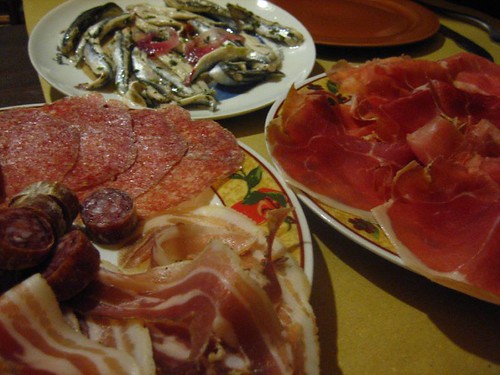
The Italians have good food. No question, right? But I’m getting a little tired of the “Made in the
Last night, I went to an Italian farmhouse for a contadino meal. It was lots of fun: they roasted meat on a grate in the fireplace, and the wine flowed freely. I knew they’d try to make me eat all kinds of fatty meats, and – all right, that’s what I expected, I wanted to sample them, and then basta! (Enough!) Really, I wanted to taste them, and a taste is all I needed. But it’s definitely not all the Italians need.
The entire meal consisted of fatty meats. First course, cured meats: Ciccioli, coppa di testa, salsiccia curata, salame. Second course, cooked meats: salsiccia mata, salsiccia fresca, pancetta, ribs, and I’m probably leaving something out. The pig is 95% useable, and, believe me – they use it. In any case, there were – I’m counting – at the very least eight different kinds of fatty meats. As I said, a bite works for me. But everyone else there, including women and children, devoured entire plates of the “appetizers,” ate a full piece of each of the cooked meats, and then asked for “seconds”! (Or would it be “ninths”?) Incredible! And disgusting, in my opinion. But, amazingly enough, and perhaps assisted by Bacchus in my noble quest for tolerance and open-mindedness, I wasn’t feeling judgmental last night. If they want to eat a diet consisting entirely of saturated fat, great, go for it. (Just as long as they don’t make me do it!)
That is, until the entire conversation turned into the usual pedagogy about how Italian food is so much superior to American food and hence Italians are so much superior to Americans. (Note the P-implies-Q causality: food is so important here that it really is a “hence.”) I figured – ho! – that, at least this time (this is a conversation that I have – or that people have on me, really, every day) they’d launch the battle on the gourmandize front. But no! In fact, we moved quickly to the health front, and the entire room agreed that the “Healthy Mediterranean Diet,” (“consisting largely of fruits, vegetables, and pasta”), shamed what Americans eat every day, which is, obviously, three meals consisting exclusively of McDonald’s hamburgers. They also said, in these exact words, “Now, you seem very thin, but all the rest of Americans are obese. Right?” I repeat: I was the only person in the room who wasn’t at least 40 pounds overweight!
No one – except for me, and I was content to amuse myself, again with Bacco’s help, by having a director’s-version conversation inside my head – seemed to note the riotous irony of the situation: A roomful of fat, slow-moving Italians devouring five pounds each of the fattiest meats you could ever find were expounding on the superior health characteristics of their diet.
That reminds me that, also yesterday, when I was at the market, the man in front of me bought two kilos of oranges. Great, good for him! Then he started to make conversation with the fruit man. “I have a ‘subscription,’” he said. “Six oranges a day. Three in the morning, and three after dinner.” I really am not being critical of this practice: six oranges a day, way to go! I just use it to illustrate the fact that nothing here is done in moderation: if you’re going to eat oranges, you’re not going to eat an orange, you’re going to eat six. And besides, from the looks of the guy, I think he also had a “subscription” to cookies.
Then today I read an article in a running magazine that included this exact phrase: “A healthy diet should include lean meats (such as Prosciutto di Parma, DOP) . . .” If prosciutto is lean, I’d really like to know what fits into the fatty category. Apparently, though, if you know where it comes from (that’s the DOP label), it’s all of sudden perfectly healthy? It’s kind of like that other theory some people have: if you bake a cake, and eat the entire thing, but in small bites right from the cake pan, and never actually take a piece on a separate plate, it’s actually the same as not eating it.
And then, also today, I heard a radio advertisement featuring a famous soccer player. “Your health is too serious to play with. That’s why I feed my team a healthy breakfast every morning: fresh milk, in-season fruit, bread, and Nutella.” If you’re not familiar with Nutella, it’s like chocolate peanut butter; its ingredients, in order of appearance, are “sugar, peanut oil, hazelnuts, cocoa, skim milk, and a bunch of chemicals.” I agree that fresh milk and fruit do constitute part of a healthy breakfast, but would anyone ever consider it ethical to advertise, say, cheesecake, as a healthy snack because you serve it with two raspberries on top?
And then I read another publication, a health booklet published by the Italian Association of Dietetics and Nutrition, and I found the standard “health pyramid.” But wait a minute! The health pyramid isn’t actually standard. This was the “Italian Food Pyramid,” labeled just like that. In this health pyramid, they actually include cookies in the same (recommended) category as pasta, rice, bread, and potatoes. They don’t make any distinction between whole grain and refined-grain products, probably because whole grain products don’t exist here. And, also notably, “Oils and Fats” are more highly recommendable than “Milk and Yogurt.” I can’t be the only person who thinks such a recommendation is absurd. I’m a pretty big fan of the scientific method; is laboratory science in
I’m not saying that the Italians shouldn’t eat like crap. If that's what gets them going – and does it ever! – right on, they should go all out. But I am saying that they should look at themselves a bit more objectively, and that they should somersault right off that high horse they’re riding.
Tuesday, April 22, 2008
How I Became Italian

Saturday I took a major step in becoming Italian: I stopped playing fair, thought only about myself, broke the rules, and got what I wanted. I ran in the middle of the street and didn’t worry that I was pissing off the car behind me. I cut in line – in major fashion – at the film festival, elbowed my way to the front, and got one of the last tickets. And, best of all, I brought a plastic bag with me to the movies and rustled it as much as I could.
In fact, I think I’m going to repeat these activities intentionally next weekend, so as to reinforce the Italianization process. It’s still not quite natural for me: I’m starting to be rude and self-important (though still not fashionable), but I still feel guilty about it. I’m thinking that if I keep up the effort, though, I’ll be able act entirely without thinking about anyone else, with entire self-absorption, and with no Catholic guilt!
Sarcasm aside – ha! had you there! It’s almost back. – I have to go back in time a little to get back to today.
The Cineteca of Bologna is an awesome institution, and it’s always doing cool film series and hosting film festivals. (It’s the best. Every city should have a Cineteca!) Right now is the Human Rights Film Festival, and I’m trying to catch as many films as I can. I think there’s something wrong about the Human Rights Film Festival being the catalyst and place of my conversion to self-centered rudeness, but there you have it.
I went to a film the other night with my friend. Naturally, there was a line a half hour long, not because there were so many people, but because, despite the prestige and international character of the event, it was taking place in Italy and therefore had to impose a disorganization, and lines. There was a single person issuing tickets, and, this is great: You needed to buy not only a ticket for the film, but also a membership card – I told you, they’re huge! – to the Cineteca, which, interestingly, doesn’t ordinarily require a membership card. But not only that! You had to choose which type of membership card you wanted, and then determine whether you qualified for one of the discounts: Student? Member of the Food Coop? Patron of UniCredit Bank? And so on. So every single person in line got to the front, squinted at a full page of 8-point pica print describing the various membership options, and, after half an hour, stumbled away with his ticket (and brand new membership card). So then everyone got into the theater, the event started half an hour late, and the director introduced the film. They started the film, and, then – fifteen minutes later – realized that – whoops! – it’s the wrong film! (How do you get fifteen minutes into a film which the director has just introduced without realizing it’s the wrong film?) Ok, it can happen. Maybe. They stopped the film, and two of the festival directors went to the front to say, “Sorry. Wrong film.” And this was great, just classic: one director did that thing where you kind of shrug your shoulders, flop your arms out to the side, cock your head, and scrunch up half of your face, and she said, “So . . . do you guys want to continue with this film, or should we change to the scheduled film?” The 200 people in the audience were (surprisingly?) not of one mind or voice, and so the other guy repeated the question. People in the audience started shouting . . . This one! That one! Then they started negotiating: “If we play the one that’s supposed to run tomorrow today, can we play the one that’s supposed to run today tomorrow?” Just imagine if you went to the Regal to see Top Gun, and the cinema people told you, “Oh, sorry. Turns out we actually played Top Gun yesterday. Today . . . let’s see . . . yep. We’ve replaced it with Brer Rabbit and the Briar Patch. Another great film!” Actually, if the equivalent holds, it would be a beautiful, stylish, 25-year-old girl or guy telling you this, and you’d probably obediently buy a (supersized) popcorn with extra butter and settle down to an evening of Disney enjoyment. But that’s not the point. I went with an Italian friend, and his analysis of the situation was right on target: “Only in
All this is to point out several key characteristics of Italian living: Organization is always horrendous, you always need a membership card, there will always be a line, and the people around you will always look tremendous.
Back to today, finally. It was a fantastic, full of great things. That’s the thing: It’s disorganized and there’s a line – but if you can parse your way through the disorganization and work your way to the front of the line,
The lecture was awesome, but almost as impressive was the concentration of the Rude Fashionable Old Italian Ladies. It was like an RFOIL convention. If you’re at all attentive, you can spot an RFOIL ahead of time based on visual clues, but I wasn’t so attentive upon my arrival and hence had chosen a seat located in a zone of particularly high RFOIL concentration. I knew this several minutes into the lecture when my (fairly low) aural skills started to pick up on a crinkling, which soon escalated to levels you might find in, say, a plastic bag factory. (I assume they make plastic bags in a plastic bag factory? I’ve never really thought about it before.)
The RFOIL is an Italian institution, and, as I said, she’s easy to spot. She’s an over-65, but she’s made-up to seem, say, “dating age.” This always includes pointed, high-heeled shoes, a fashion scarf, lots of makeup, and – the giveaway – an enormous fashion handbag. I use the word handbag, even though I’m not from
Of course, it’s not really just plastic bags: I know there are also a few other items. A cell phone, for example, which is never turned off, and which is programmed to sound in the middle of the concert. A few other wallets. For example, one might be for cash bills, another for coins, and another for ID cards. All together, they’re kind of like a matrioska doll. This means that, if you are at the supermarket, in line – after waiting a half hour, naturally – you will arrive at the front, and the old lady one person ahead of you will take the ol’ digging-in-the-purse-for-the-exact-change routine to a whole new level. She’ll get to the front. Wait for the cashier to tell her the bill. Surpise! Time to pay! (Oh!? Now?) She’ll dig in the handbag to find the change purse. Open it up, dig around . . . oh, no! Silly me, that’s the ID card purse. Dig around in the giant black-hole handbag some more. Pull out the wallet-purse. Dig around in the wallet-purse to pull out the (even smaller) change purse. And then dig around to find eighty-seven euro-cents, exactly.
Right, so I know there’s a cell phone and a series of purses-within-purses. There is also a supply of hard candy, all packaged in a complex telescoping (like the purses) plastic wrappers. This is how you find an RFOIL in public: You listen for the plastic wrappers. If you’re worried that your sense of hearing isn’t especially keen, or that you’ll “miss the moment” while distracted: Don’t. You can’t miss it. Once unleashed, the RFOIL will dig through her purse for the entire performance. First for the cell phone (because it’s going off right now, and playing Like a Virgin). Then for the change purse. And finally for the plastic wrapper. I mean the candy. No, on second thought, I think it actually is the plastic wrapper she’s going for. Wrap. Unwrap. Wrap. Unwrap. Deposit in purse once again. Man, does she ever get a lot of use out of that wrapper. Then she’ll decide she wants another piece of hard candy, and... . Repeat. For the entire performance, no kidding. And remember: the entire handbag is padded with plastic bags! Whoo!!! Plastic!!!
In case you’re wondering, Younger people usually skip the plastic wrappers and select from the multiple choice of other disrespectful lecture/concert/cinema behaviors, the two preferred choices being (1) talking through the entire performance, to oneself, if necessary; and (2) making out, noisily, through the entire performance.
So: Great program at the archeological museum. But lots of stupid RFOILs with plastic wrappers.
Which, finally, brings me back to the film festival. I wanted to see two consecutive films, and I figured – ah! There I go again – that I’d buy both tickets at one time. Nope. Turns out that you can buy tickets beginning only 30 minutes before the performance starts. (This is to encourage lines.) So I went to see the first film, which, naturally, started, and hence also finished, 20 minutes late. I went to get the next ticket, and, not surprisingly, there was a line that was about half an hour long.
And that’s when I became Italian! I decided that the line didn’t apply to me. An every-man-for-himself fury swept over me, I furrowed my eyebrows, and began the mission to GET WHAT I WANTED. My first effort, a bit too reasonable, was to approach a theater worker and explain that, since I was participating in the festival by attending the 6:15 screening, it was hence impossible for me to get in line early to buy a ticket for the 8:30 show, and that this didn’t make any sense and would in fact discourage people from attending the lesser-known films, and that hence she should give me a ticket without making me wait in line. (This was true, and entirely reasonable, but still, I felt downright sneaky.) She agreed that my dilemma was absurd, and that they should come up with a better system, but, “I can’t do anything, this time. Sorry.” But, no problem! I didn’t let that stop me. I’m Italian now! I scanned the crowd, found a young guy, joked around a little bit, and . . . basically inserted myself into the line right there. Which was the the front.
About 200 people got left in line. I got one of the last tickets. And that’s how I became Italian.
Subscribe to:
Posts (Atom)